
Physiotherapy and visceral therapy
Visceral therapy in physiotherapy: what it involves, which complaints it's used for and whether it has side effects. We explain it step by step.
Book online 24/7 · visits Mon–Fri 7:00–21:00, Sat 7:00–14:00 · 2 clinics in Kraków
Looking for treatment in person? Visceral therapy in Kraków – visceral osteopathy in Kliny and at ul. Wolska 2a.

How do they differ, and when can they complement each other?
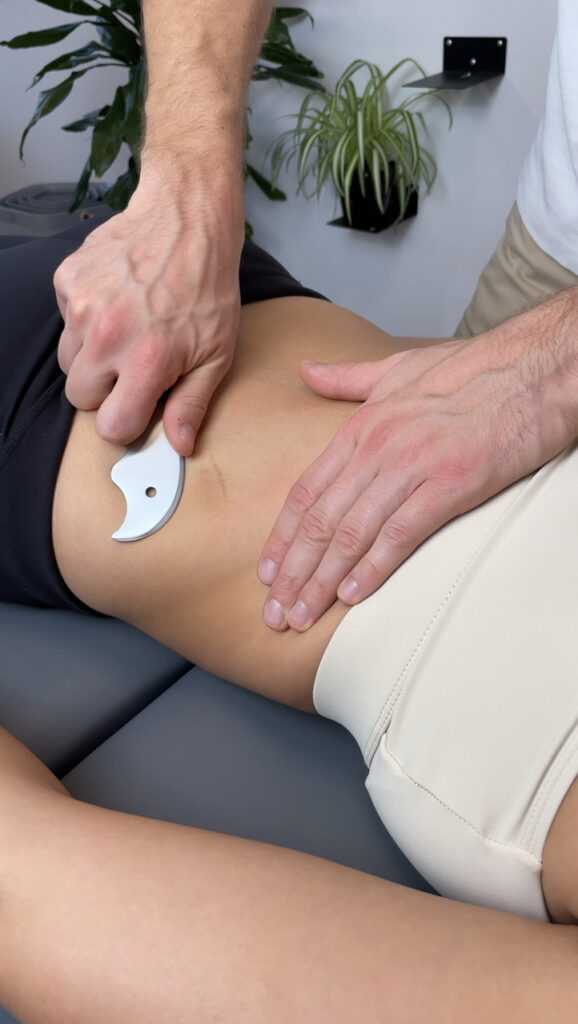
Visceral therapy is a form of manual therapy in which the therapist works with the tissues of the abdominal and thoracic cavities and their connections with the musculoskeletal system.
However, this doesn't mean "repositioning organs" or treating diseases of the internal organs with pressure. In practice, it's one of the manual methods that can be used as part of a broader physiotherapy process – alongside a movement assessment, manual therapy, breathing work and appropriately chosen exercises.
How does visceral therapy differ from conventional physiotherapy?
Physiotherapy covers a much broader scope. During an appointment, a physiotherapist may assess, among other things, joint mobility, muscle strength, movement patterns, nervous system function, previous injuries and which movements or positions aggravate the symptoms.
Visceral therapy can be one element of this assessment and treatment.
Within the abdominal cavity, the organs do not function in complete separation from the rest of the body. They are surrounded by the peritoneum, fascia and supporting structures, and lie in close anatomical proximity to the diaphragm, spine, pelvis and abdominal muscles.
For example, it is worth considering:
- the diaphragm, which separates the chest from the abdominal cavity and works together with the abdominal muscles during breathing,
- the thoracolumbar fascia, which connects many structures of the trunk and helps to transfer load,
- the psoas major, which runs deep within the abdominal cavity close to the lumbar spine,
- the pelvic floor muscles, which work together with the diaphragm and abdominal muscles,
- the connective tissues and fascia surrounding individual structures of the abdominal cavity.
This is why, in a patient with back pain, restricted trunk mobility or a feeling of abdominal tension, a physiotherapist may examine not only the painful area but also how the diaphragm, abdomen, hips and pelvis are working.
However, this does not mean that every spinal complaint originates from the internal organs. Assessment and differentiation of the possible causes of the problem must come first.
What can visceral therapy involve?
Visceral therapy usually uses gentle manual techniques applied through the abdominal wall or to the neighbouring tissues.
The therapist may assess, among other things, the tension and mobility of the tissues around:
- the diaphragm,
- the upper abdomen,
- the intestines,
- the liver area,
- the stomach,
- the pelvis,
- post-surgical scars.
The work does not have to be limited to the abdomen.
One example is the diaphragm. It is the main muscle of respiration, but it also attaches to the lower ribs and the lumbar spine. If we notice restricted breathing mechanics during the assessment, this may be one of the elements taken into account in treatment.
Similarly, in the case of a scar from abdominal surgery or a caesarean section, a physiotherapist may assess the mobility of the scar itself and of the surrounding tissues.
A broader view also takes the nervous system into account. The internal organs have autonomic and sensory innervation, and information from the organs and from musculoskeletal structures reaches the nervous system. This is one of the reasons why visceral and musculoskeletal complaints can sometimes occur at the same time.
However, this does not mean that manual therapy can “repair the vagus nerve”, improve the function of a specific organ or cure a gastrointestinal disease. If you have symptoms such as persistent severe abdominal pain, bleeding, fever, unintentional weight loss or other worrying complaints, what you need first and foremost is appropriate medical investigation.
Research into visceral therapy is still developing. Some studies suggest that, as an addition to standard physiotherapy, it may influence pain and function in selected patients, including those with chronic musculoskeletal pain. At the same time, research reviews highlight the small number of good-quality studies and the need for further analysis.
When can visceral therapy be part of physiotherapy?
The most important thing is not to choose a treatment based on the name of the method.
Patients should not come in with the assumption: “I need visceral therapy”. The first step is to establish what their problem is related to.
For example, a patient reports:
- recurring lower back pain,
- a feeling of abdominal tension,
- restricted trunk mobility,
- discomfort around the lower ribs,
- difficulty taking a deep breath,
- complaints in the pelvic area,
- restricted mobility of a post-surgical scar.
The assessment may show that it is worth working on hip movement, strengthening the gluteal and trunk muscles, improving how the diaphragm works and using manual therapy in the abdominal area.
For another patient, visceral therapy may not be needed at all.
That is why at FizjoStyl we see it as one of the available tools, not a standalone solution to every problem.
At the first appointment, we begin by taking a history and carrying out an assessment. Among other things, we check the musculoskeletal system, the areas related to the symptoms and the factors that may contribute to them. Only then do we select the treatment – it may include manual work, visceral therapy, exercises, breathing work or a combination of several methods.
The most important thing is not the choice of a particular technique. The most important thing is understanding the problem and matching the treatment to the individual patient.
Need help in person? Visceral therapy in Kraków – we provide it as part of visceral osteopathy, in Kliny and at ul. Wolska 2a.
Want to talk it over with a physiotherapist?
Book a free 15-minute consultation. We will talk about your problem and, if you wish, continue straight into a full visit.
See how you can help yourself
Heartburn: a stretching exercise
Pressure under the left rib arch, lean back and turn your head to the right.
Bloating: relaxing the abdomen
Hands on your tummy, calm breathing and gentle side-to-side movements until you feel it relax.
Stress and digestion
Why we digest worse under stress and how breathing helps switch the body into rest mode.
Heartburn: trunk rotations with breathing
10 trunk rotations to each side with deep breathing – gets the diaphragm moving.
The exercises in these videos are general guidance. If your pain is severe, getting worse or not going away, book a consultation.
Wolska 2a clinic
Prokocim, next to the Bieżanowska stop. Parking in front of the building.
See the clinic →