
Craniosacral osteopathy
Craniosacral therapy in Kraków: a gentle osteopathic technique for headaches, tension, stress and sleep problems. Book a visit.
- 230 zł · 45 min
- ★ 5.0 · 264 reviews on Google
- Free consultation
Book online 24/7 · visits Mon–Fri 7:00–21:00, Sat 7:00–14:00 · 2 clinics in Kraków
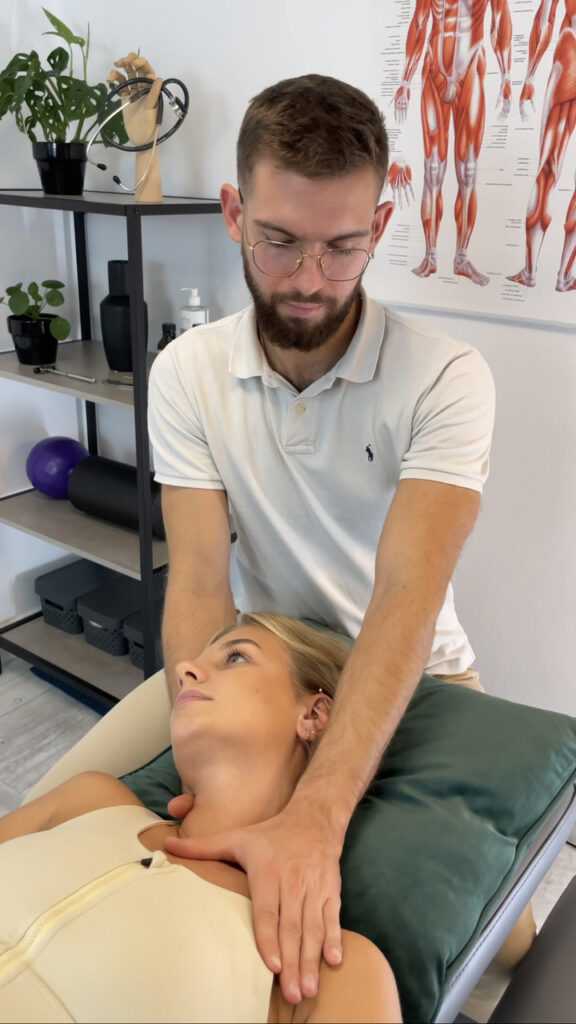
Restoring structural balance in the skull and sacrum
Craniosacral osteopathy is a speciality within osteopathy that focuses on diagnosing and treating dysfunctions related to the skull, the sacrum and the surrounding structures.
Craniosacral osteopathy
Using gentle manual techniques, craniosacral osteopaths aim to restore structural balance, reduce muscle tension and improve the function of joints and tissues in the head, face, neck and sacrum.
This form of osteopathy is used in the treatment of headaches, migraines, temporomandibular disorders, balance and postural problems, and to support rehabilitation after injuries or surgery.
Craniosacral osteopathy can also be used with children and infants, particularly when there are feeding difficulties or sleep problems.
This holistic approach to health focuses on the integral connection between the body's structures and their effect on the patient's overall wellbeing.
Who is it for?
Headaches and migraines
Craniosacral osteopathy can be used to treat headaches and migraines, which are often linked to tension and dysfunction of the cranial structures.
Temporomandibular disorders
Osteopathic manipulation of the skull can affect the temporomandibular joint, which is important in TMJ (temporomandibular joint) dysfunction – that is, problems opening and closing the mouth, jaw pain and other related symptoms.
Balance and postural problems
Craniosacral osteopathy can be used to restore structural balance, which can affect posture and reduce muscle tension.
Sleep disorders
Disturbances of the cranial structures can affect sleep quality. Craniosacral osteopathy can help reduce tension, improve the flow of cerebrospinal fluid and improve sleep quality.
Treatment after injury
After injuries to the head or sacrum, craniosacral osteopathy can be used to support healing, reduce pain and restore the function of the structures.
Use in neonatology
Craniosacral osteopathy is sometimes used with newborns and infants who have feeding difficulties, restless sleep or other problems resulting from dysfunction of the cranial structures.
Post-operative problems
After surgery on the skull or sacrum, craniosacral osteopathy can be used as part of rehabilitation, supporting healing and restoring the function of the structures.
When to see a doctor first
Craniosacral therapy is not a substitute for medical care.
Contact a doctor urgently if your headache comes with vision problems or vomiting, gets worse when you cough, sneeze or bend over, or if you have jaw pain when eating and a tender scalp.
If your headache came on suddenly and is very severe, you have numbness or weakness in your face or body, difficulty speaking, walking or keeping your balance, you are drowsy or confused, you are losing your vision, you have had a seizure, or you have a high temperature with a stiff neck – call 112 or go to A&E.
In babies: contact a paediatrician if your baby is not gaining weight as they should. If your baby's cry is weak, high-pitched or sounds different from usual – call 112.
Therapists


See how you can help yourself
Headache without pills: relaxing the back of the head
Lying on a mat, place your fists under the back of your head and make small up-and-down movements with your head until you feel it relax.
An eye exercise for headaches
Keep your head still, look to the right for a minute, then to the left for a minute – relaxes the head and neck area.
Neck lengthening with breathing
Hold yourself under the ribs, take a deep breath in, and as you breathe out press your neck into the mat – repeat for a few minutes.
The exercises in these videos are general guidance. If your pain is severe, getting worse or not going away, book a consultation.
What our patients say
I highly recommend Ms Kinga! Thank you for the pleasant atmosphere during our sessions, which aren't always easy and can be painful. I'm undergoing rehabilitation for an elbow joint contracture after surgery and I regularly see progress. A professional approach and a great atmosphere!
I came to Kinga with a complex problem. The appointment began with a thorough consultation and detailed information about what would happen and how. After the first session the acute pain was gone, and after the next one I not only became aware of what I need to work on, but also received a set of exercises that has enabled me to manage the pain on a daily basis.
I absolutely recommend her. After a few sessions I not only feel better, but I also have a diagnosis, I know the cause and I know what to do – and it all works.
I have complete trust in her and feel comfortable during therapy. Sadly, there are too few specialists like her who, in addition to enormous knowledge and experience, also have empathy and take a truly individual approach.
I highly recommend him! You can see that Mr Konrad approaches his work with great dedication and, above all, wants to find the real cause of the problem rather than focusing solely on relieving the symptoms. Everything is analysed and explained thoroughly, and the approach itself is very professional. You can feel that Mr Konrad genuinely cares about actually helping the patient, not just doing his job. Complete dedication, knowledge and a great approach to the patient. I highly recommend him to anyone looking for a physiotherapist with a true vocation!
I highly recommend FizjoStyl and in particular Mr Gruszka, who really knows his stuff and teaches exercises that actually work!
I recommend.
I highly recommend the FizjoStyl practice, a very professional approach to the patient and a wonderful way with children. Both Mr Bartłomiej and Mr Konrad are excellent specialists and have helped us a great deal.
A nice visit, a detailed history and my doubts cleared up. I was examined and shown which exercises to do and how to do them. I recommend 🙂
Help in the fight against pain, the exercises worked.
Reviews are written by patients on Google, ZnanyLekarz and Booksy – we do not moderate them. The cards automatically show the latest Google reviews, translated from Polish. Review counts are updated daily.
Not sure if we can help?
Book a free 15-minute consultation. We will talk about your problem and, if you wish, continue straight into a full visit.
Frequently asked questions
What does craniosacral therapy involve?
It is a gentle osteopathic technique. The therapist works with their hands around the head, face, neck and sacrum to restore structural balance and reduce muscle tension.
Is craniosacral therapy the same as cranial-sacral therapy?
Yes. It is the same method under different names: cranial-sacral therapy, cranio-sacral or sacro-cranial therapy.
When is craniosacral therapy worth choosing?
We use it for conditions including headaches and migraines, balance and posture disorders, and sleep problems. It can also form part of rehabilitation after injury or surgery to the head and sacrum.
Can craniosacral therapy be used for jaw pain?
Yes. Techniques around the skull can affect the temporomandibular joint, so we use them for jaw pain and problems opening or closing the mouth. For teeth grinding, see also dental physiotherapy.
How much does craniosacral therapy cost?
230 zł for a 45-minute visit. The therapy is provided by Konrad Niziankiewicz and Mateusz Sędzielewski.
Do I need a referral?
No. You can book a visit without a referral – just choose a time online or give us a call.
Do you accept patients through the NFZ (Polish public health fund – our clinic is private)?
No, we only see patients privately. You will find our prices in the price list.
Where are you based?
We have two clinics in Kraków: ul. Wolska 2a (Prokocim) and ul. Wicherkiewicza 23/K (Kliny). Home visits are also available.
What should I bring to my first visit?
Any imaging results you have (X-ray, ultrasound, MRI) and discharge summaries, plus comfortable clothing. Find out more in the patient information.
How do I book?
The quickest way is online – the “Book a visit” button opens a calendar with available times. You can also call: 881 505 588 or book through Booksy or ZnanyLekarz.
I don't know which therapist to choose. What should I do?
Book a free 15-minute consultation. We will discuss your problem and suggest which therapy and which therapist suit it.