
KOBIDO – the Japanese art of facial massage
What is KOBIDO, how does Japanese facial massage work and how often should it be repeated? A FizjoStyl physiotherapist from Krakow explains.
Book online 24/7 · visits Mon–Fri 7:00–21:00, Sat 7:00–14:00 · 2 clinics in Krakow
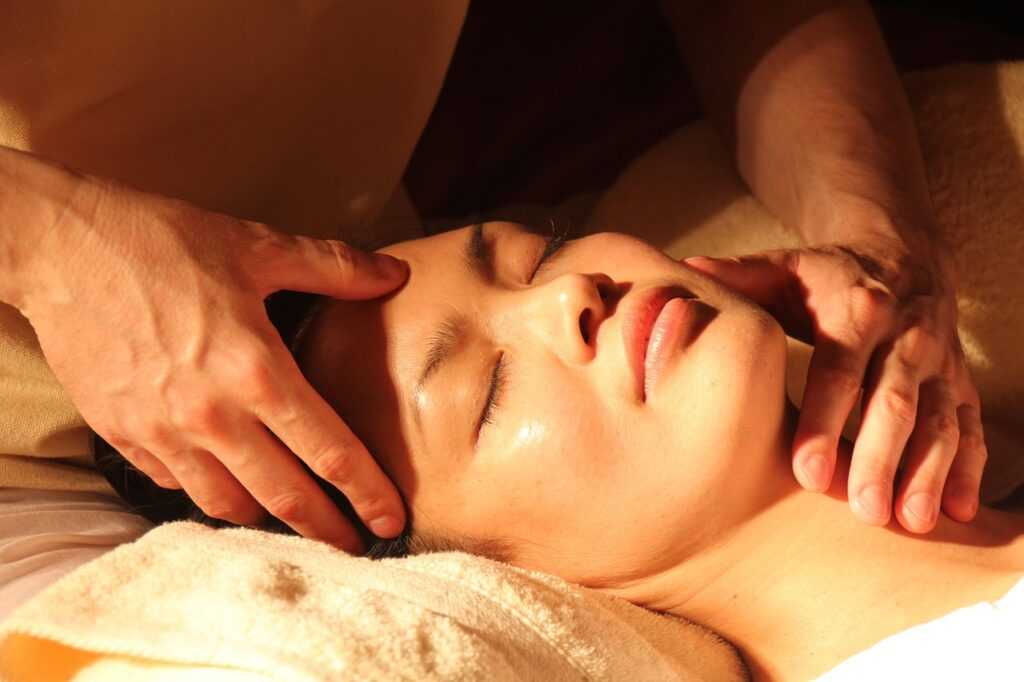
KOBIDO massage is a traditional Japanese manual technique that focuses mainly on the face, neck and décolletage. The name "KOBIDO" is translated as "the ancient way of beauty", which captures the character of the method well – it combines precise manual work with rhythm, changes of pace and techniques applied to different layers of tissue.
KOBIDO is often chosen by people who want to take care of the appearance and tone of their skin, but also by those who feel tension in the muscles of the face, jaw or neck.
What does KOBIDO massage involve?
KOBIDO is not one uniform way of massaging the face. The treatment may include gentler superficial techniques, soft tissue work, faster stimulating movements and relaxing elements.
During the massage, the therapist works on, among other things:
- the skin and subcutaneous tissue,
- the facial fascia,
- the muscles of facial expression,
- the chewing muscles,
- the neck area,
- the décolletage.
In practice, this means working on structures such as the frontalis, orbicularis oculi, orbicularis oris, the zygomatic muscles, the masseter and the temporalis.
The muscles responsible for facial expressions and jaw tension are particularly important. In people who often clench their teeth, work under stress or spend long hours at a computer, the face and neck can be noticeably tense.
The massage can affect the tissues mechanically through pressure, gliding and stretching, but also by stimulating the sensory receptors in the skin and soft tissues. The body's response to touch is individual and depends, among other things, on tension, pain, previous experiences and the overall arousal of the nervous system.
What effects can KOBIDO massage have?
KOBIDO is mainly associated with improving the appearance of the face. After the massage, the skin may look more rested, and the tissues may be more relaxed and have better blood flow.
This effect is linked, among other things, to the mechanical action of the massage on the tissues and the local stimulation of circulation and sensory receptors. In FizjoStyl materials we describe massage precisely as a stimulus that affects the tissues, the nervous system and local circulation, not as a method that works the same way for everyone.
KOBIDO may be particularly interesting for people who experience:
- tension in the facial muscles,
- a feeling of a "heavy" or tired face,
- jaw tension,
- neck tension,
- stress and difficulty relaxing.
However, this does not mean that KOBIDO treats bruxism, temporomandibular joint disorders or other medical problems. If the main symptom is pain, limited mouth opening, clicking in the joint, severe headaches or chronic teeth clenching, it is worth considering a physiotherapy or dental consultation rather than relying solely on a relaxation massage.
Need help in person? Physiotherapy in Kraków – FizjoStyl: clinics in Kliny and at ul. Wolska 2a.
Want to talk it over with a physiotherapist?
Book a free 15-minute consultation. We will talk about your problem and, if you wish, continue straight into a full visit.
Wolska 2a clinic
Prokocim, next to the Bieżanowska stop. Parking in front of the building.
See the clinic →